Our perception of wealth is often personal and shaped by our own experiences. I began to notice this divide while talking with friends from different backgrounds about what being rich meant to them. One of my best friends, who had lived for some years in the community housing projects in Toronto, considered being rich to be being able to pay your mortgage and bills comfortably. Meanwhile, another friend, whose family owns a successful restaurant, said he would consider himself rich if he owned a Lamborghini. Clearly, two wildly different views of what it means to be rich, from two wildly different backgrounds. Indeed, I would argue that human greed (or ambition, whichever you prefer) makes it difficult to be cognizant of one’s own class. When asked to define rich, we have a tendency to look up on the socioeconomic ladder – being “rich” is something that is always above your status. I’ve no doubt that there are millionaires who don’t consider themselves rich, if only for the fact that they aren’t billionaires.
Given that people’s concept of wealth is subjective, what then does it truly mean to be rich? For a more objective exploration, we might consider studying the statistical distribution of income in Canada’s population, courtesy of Statistics Canada.
The graph below shows the percentiles of income distribution of individuals (not households) in Canada using data from the 2016 Census, the most recent data of its kind.
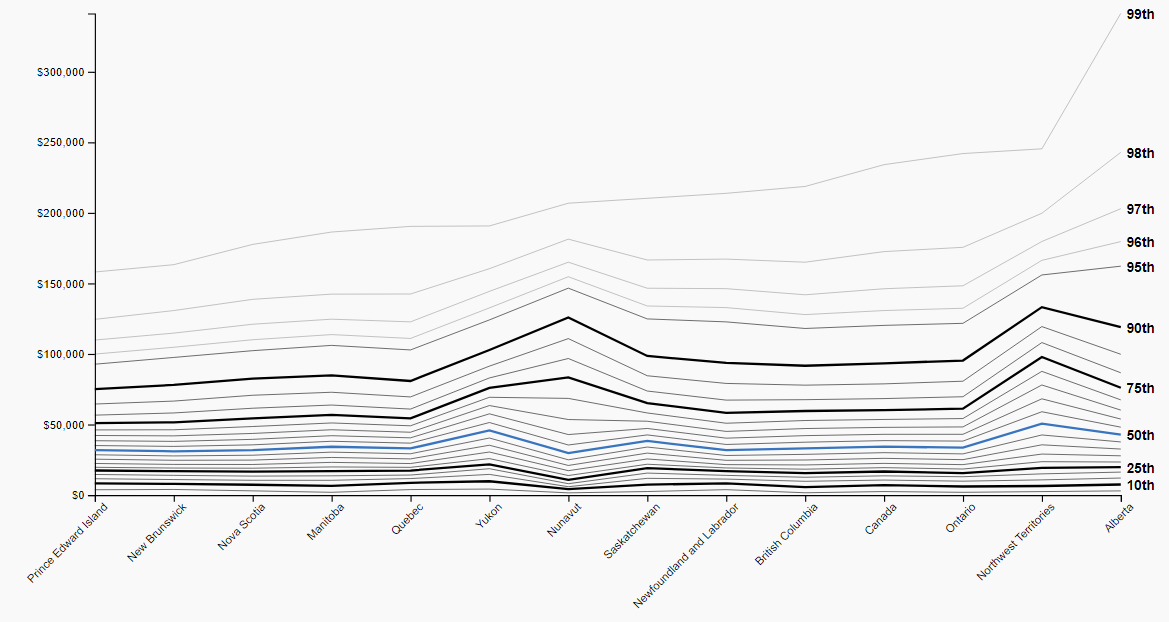
While StatsCan also publishes exact values for these statistics, visual estimates from the graph will suffice, for fear of the details distracting from the main point of the article. The blue line, representing the median, or the “middle” of the distribution, shows the income threshold that exactly equally divides the population: 50% of people are above that line, and 50% of people are below that line. This appears to be around $35,000 in Canada, and slightly lower or slightly higher depending on the specific province.
The line I’m interested in is the topmost one – the 99th percentile. This represents the income at which one makes as much or more money than 99% of the rest of the population (whatever population that is). Said another way, that is the line representing the infamous “1%”, everyone’s favorite group to hate. The 1% have become the poster child for people’s growing worries about income inequity in Canada and indeed the world – with good reason. An individual income of around $230,000 qualifies one to be part of that elite group in Canada, nearly 7 times as much income as the median. Interestingly, we see the 99th percentile cutoff in Alberta much higher than Canada overall, although this may have changed in recent years due to the diminishing state of the oil industry there now.
We can delve deeper into the statistics by looking at the breakdown within Ontario, my home province, shown below.

Perhaps unsurprisingly, while we see that the percentile lines are relatively the same for the various census metropolitan areas (CMAs) shown, at the very top of the income distribution, from the 95th percentile and above, Toronto is more heavily skewed than other cities in Ontario. To qualify as a 1%er among Toronto earners, one needs an income of around $300,000 – $70,000 more than the Canadian threshold, and $60,000 more than the next highest 1% threshold in Ontario (which would be Hamilton, with a 1% threshold of $240,000). Startlingly, Toronto’s 1% threshold is 10 times as much as the median income in Toronto.
Now, what is this all to say? Firstly, the gap between the 1% and the median of income earners is sizable. However, one doesn’t even need to venture into the 1% to see wide disparities in income. An income of $100,000 – about a third of what the 1%ers make – still puts you around the top 5% of earners (I say around to account for regional variances which may put you slightly above or slightly below the threshold).
StatsCan considers the “middle class” to be the middle three quintiles of the income distribution. Quintiles divide the income distribution into equal fifths, so that you have those from 0th %ile (read: percentile) to the 20th %ile, 20th %ile to the 40th %ile, and so forth until the group comprising the 80th %ile to the 100th %ile. The middle class is the middle three quintiles, meaning those whose incomes are between the 20th %ile threshold and the 80th %ile threshold. The three quintiles defining the middle class are sometimes further described as “lower middle class”, representing the lowest quintile of those three (20th %ile to 40th %ile), and the “upper middle class”, representing the highest quintile (60th %ile to 80th %ile) of those three. Rich has no concrete definition, but I’d venture to say that anyone in the top 5% (earning $100,00 or more) of earners is well beyond what we can call middle class! Note that we have been using individual income statistics, and that a household income of $100,000 would land you a spot solidly in the middle of the middle class.
All that said, while all these statistics have, admittedly, been an exercise in imbibing class consciousness, arguably the focus on the 1% is misguided if we truly wish to combat income inequality. Earners in the 1% are more commonplace than you think, and those who comprise that group tend to be professionals in healthcare, engineering, law, and management (source: Statistics Canada “Education and occupation of high-income Canadians). However, even those professionals are at the bottom rung of those supposedly elite 1%ers. If you’re looking for the real culprits of income inequality in Canada and the world, look higher up. The 0.1%, of which there are 26,850 in Canada, have a threshold of individual income of $826,800. Looking even further up on the distribution, the top 0.01%, of which there are a mere 2,685, have a threshold of a whopping $3,636,000 (!) to be a part of their privileged circle (Source: Globe and Mail).
I highlight these statistics for two reasons. Firstly, as I mentioned before, for the purposes of class consciousness – I believe it is important for people in those higher echelons of income (the 5%ers or the 1%ers or whoever you choose) to be cognizant of their elevated place in society. Being aware of the privileges afforded to oneself can engender sensitivity, compassion, and empathy towards your fellow man or woman. Secondly, the issue of income inequality is shaping up to be one of the great social and economic problems of our time, and prolonged concentration of money into the hands of the few on the backs of the toiling masses threatens to return us to the feudalistic or aristocratic days of old. Indeed, historically, such systems tend to not end well (think: French Revolution). That said, the focus on “the 1%” is perhaps slightly misguided in the populist crusade against the rich, and indeed the group actually being targeted in equality-focused economic policy such as the so-called “millionaire’s tax” isn’t the 1%, but their far more exclusive compatriots, the 0.1% or the 0.01%.
Sources
Statistics Canada. Total income explorer, 2016 Census. https://www12.statcan.gc.ca/census-recensement/2016/dp-pd/dv-vd/inc-rev/index-eng.cfm
Statistics Canada. Education and occupation of high-income Canadians. https://www12.statcan.gc.ca/nhs-enm/2011/as-sa/99-014-x/99-014-x2011003_2-eng.cfm
Globe and Mail. Canada’s 1 per cent gets another big income boost (Rachelle Younglai 2017). https://www.theglobeandmail.com/report-on-business/economy/canadas-1-per-cent-gets-another-big-income-boost/article36993871/
 Maaz's Notes